


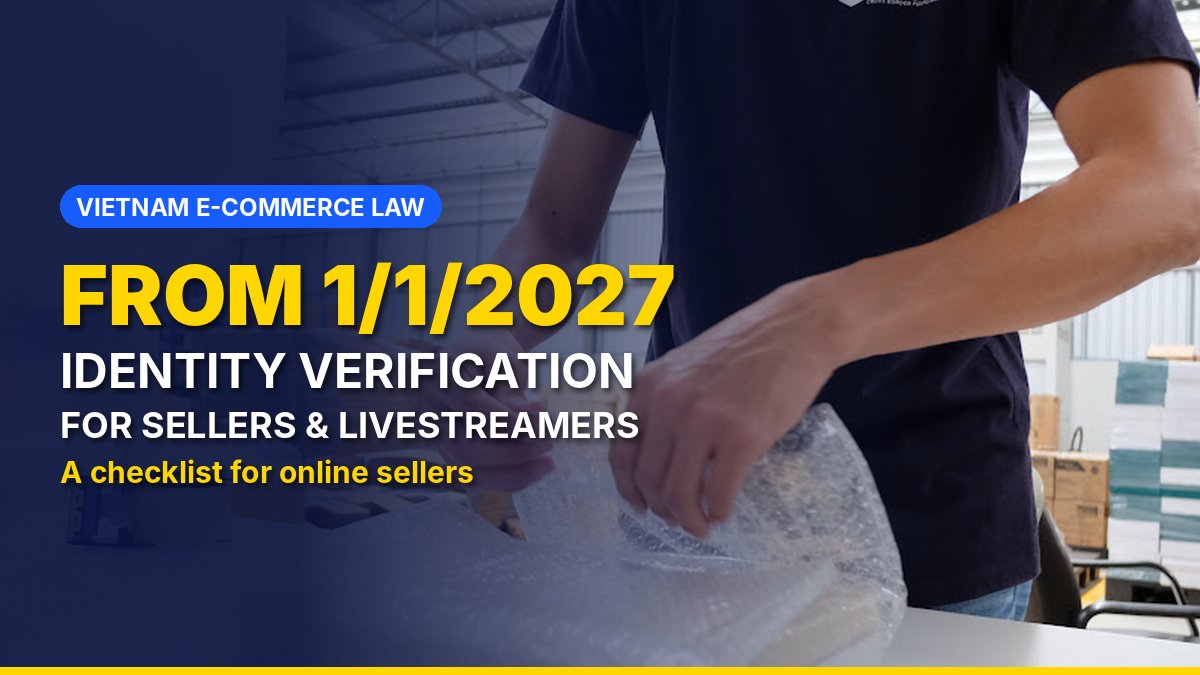
Vietnam’s E-commerce Law No. 122/2025/QH15 has been in force since 1 July 2026. But the date sellers should circle in red is 1 January 2027: from then on, platforms must electronically verify the identity of every seller and every person livestreaming sales. With less than a month to go, now is the time to review your documents, accounts and warehouse processes.
What does the new law change?
Until now, e-commerce in Vietnam was governed mainly by Decree 52/2013 and Decree 85/2021. The 2025 E-commerce Law, passed by the National Assembly on 10 December 2025, is the country’s first dedicated law for the sector. On 30 June 2026, the Government issued Decree 248/2026/ND-CP with detailed guidance.
The points that affect sellers directly:
- Platform classification. For the first time, the law sorts platforms into four types: direct-sales platforms, intermediary platforms, social networks that conduct e-commerce, and integrated platforms. Each type’s responsibility depends on how involved it is in transactions.
- Sellers may only operate after e-identity verification. Platforms must verify sellers and publish seller information.
- Livestream selling and affiliate marketing are regulated separately. Platforms must verify livestreamers, provide a channel for complaints during the stream, and store audio and video data. Livestreamers must not give false or exaggerated claims about product quality or use.
- Violating listings removed within 24 hours. Under Decree 248, platforms must take down information on violating goods or services within 24 hours of a request from a competent authority.
- Foreign platforms must register. Foreign platforms with a Vietnamese interface, a “.vn” domain, or a set level of transactions with Vietnamese buyers must register with the Ministry of Industry and Trade and set up a legal entity or appoint a representative in Vietnam.
- Green e-commerce incentives. The law introduces incentives for low-emission infrastructure, eco-friendly packaging and optimized logistics.
Why 1 January 2027 matters
Decree 248 took effect on 1 July 2026, except for the requirement that platforms electronically verify sellers and livestreamers, which applies from 1 January 2027. In other words, platforms are in a transition period and will tighten enforcement at the start of next year.
For sellers, the real risk is operational rather than legal: an unverified account could be restricted right in the middle of the Lunar New Year (Tết) peak, when every day of disruption means lost orders.
Seller checklist before 1 January 2027
1. Seller documents
- Make sure legal details (business or household business name, tax code, legal representative) match across your business license, bank account and every marketplace account.
- List every shop you run on Shopee, TikTok Shop, Lazada, Tiki and your own website. “Side” shops registered under employees’ or partners’ names are the easiest to miss.
- Follow each platform’s verification notices and complete them early rather than at the deadline.
2. Livestream team, KOLs and KOCs
- List everyone who livestreams for you (in-house and hired) and ask them to complete identity verification on the platform.
- Before each stream, give livestreamers proof of eligibility for conditional business lines and the advertising content approval if the product requires one.
- Standardize scripts so that claims about use, ingredients, origin and price match the product records.
3. Product records and origin
- Review product pages: origin, manufacturer, expiry date, instructions for use.
- Keep import documents, invoices and product declarations ready to respond the same day if a platform asks. With the 24-hour takedown rule, a product with missing documents can be hidden before you have time to explain.
4. Warehouse and operational data
- Make sure stock can be traced by batch and expiry date, and matches what is shown on the marketplace.
- Keep packing videos and outbound history for every order. They are key evidence in disputes, especially for orders from livestreams.
- Prepare a returns process: items disputed after a livestream should be received, inspected and recorded clearly.
Where fulfillment comes in
The new law expects sellers to prove three things: who they are, what their goods are, and how the goods reached the buyer. The last two are warehouse questions.
An all-in-one fulfillment partner with batch and expiry tracking, packing cameras and a returns inspection process gives sellers the data they need when a platform or customer asks, instead of digging through manual records.
Conclusion
The 2025 E-commerce Law moves the market towards greater transparency, and serious sellers stand to benefit as anonymous sellers are phased out. The immediate to-do is to complete verification before 1 January 2027 and get product and warehouse data in order ahead of Tết.
Need to review your warehouse and packing process before peak season? Contact Boxme for advice.
This article is for information only and is not legal advice. Sellers should refer to the original texts of Law 122/2025/QH15, Decree 248/2026/ND-CP and each platform’s guidance.