

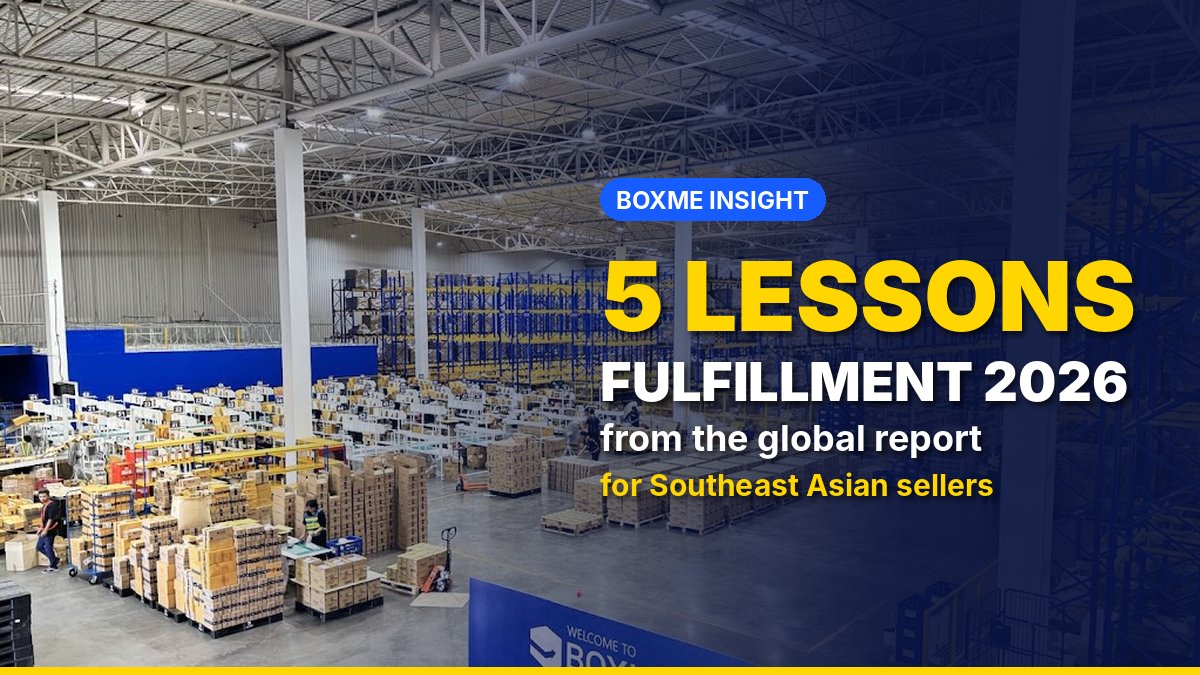
In early 2026, ShipBob, one of the largest fulfillment providers in the US, published its fifth annual State of Ecommerce Fulfillment report. It is based on a survey of 416 e-commerce executives and operating data from thousands of brands. The markets differ, but many of the trends in the report are playing out in exactly the same way in Vietnam and Southeast Asia.
Key numbers
According to the report:
- 92% of brands grew year over year.
- 86% of brands sell on two or more channels, and 75% plan to add at least one new channel in 2026.
- 84% of brands use a third-party fulfillment provider for at least some of their orders.
- 70% of brands have compliance requirements (such as GMP or GFSI) for their fulfillment partner.
- 44% plan to ship to new countries, and 44% will increase their number of fulfillment centers.
- 80% of brands add personalized touches to orders (cards, gifts, custom packaging).
Lesson 1: Omnichannel is the default, not an option
The report calls this trend “omnichannel is king”. Beyond online channels, 53% of brands already sell through B2B channels or physical stores.
In Vietnam, running Shopee, TikTok Shop, Lazada, a website and distribution to resellers at the same time is now normal. The challenge is that one warehouse has to serve many channels with different requirements: single B2C orders need speed, while B2B bulk orders need correct paperwork and delivery schedules. The answer is shared inventory synced in real time, rather than separate stock for each channel. See also B2B fulfillment.
Lesson 2: Put stock close to customers
ShipBob says brands using its multi-warehouse inventory placement program cut shipping zones by 15% and increased in-region fulfillment by 16%. 69% of brands aim to deliver domestic orders in 2–3 days.
In Vietnam, the familiar challenge is the length of the country from North to South. Intra-regional orders are faster, cheaper and returned less often than inter-provincial ones. Once volume is large enough, splitting inventory between both ends of the country improves both speed and cost.
Lesson 3: Grow order value instead of parcel count
The report’s first two recommendations are to sell bundles to raise average order value and reduce the number of parcels, and to display free-shipping thresholds to encourage customers to add more.
With marketplace fees and shipping costs both rising, every parcel you avoid is a cost saved. Bundles, gift boxes and product sets are also a way to stand out, especially around holidays and Tết.
Lesson 4: Costs are volatile, so you need a flexible partner
80% of surveyed brands said the 2025 US tariff changes increased their business costs. In Southeast Asia, sellers face similar volatility: changing marketplace fees, fuel surcharges and new tax rules.
This is one reason outsourcing rates are so high: instead of carrying the fixed costs of an in-house warehouse, businesses move to costs that scale with volume. Learn more about outsourced fulfillment.
Lesson 5: AI readiness starts with clean data
At its Fulfilled 2026 event, ShipBob introduced an MCP connection that lets sellers work with warehouse data through AI assistants such as Claude, along with an AI assistant built into its dashboard. Their core message: to use AI, businesses need clean operational data, good APIs and a connected fulfillment network.
For sellers in Vietnam, the first step isn’t buying AI tools but standardizing data: consistent SKU codes across channels, accurate inventory, and complete order and returns history. That is the foundation every analytics, forecasting or automation tool will depend on.
Conclusion
ShipBob’s report shows what growing brands have in common: they sell across channels, place stock close to customers, optimize every parcel and rely on fulfillment partners with good data. This holds true in the US and in Southeast Asia, where the market is shifting from a race on price to a contest of operational capability.
Explore Boxme’s all-in-one fulfillment for multichannel sellers.
Source: ShipBob, 2026 State of Ecommerce Fulfillment Report and its Fulfilled 2026 event recap.