

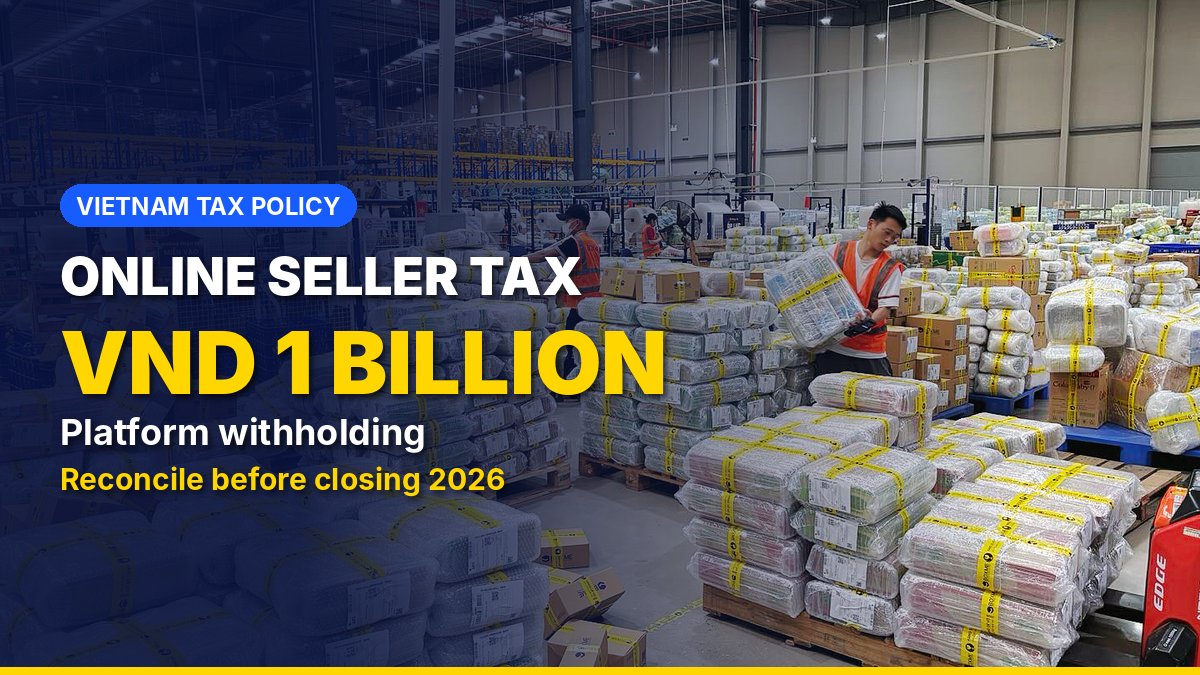
2026 brought the biggest tax changes yet for online sellers in Vietnam: presumptive (lump-sum) tax was abolished, platforms now withhold tax on sellers’ behalf, and the tax-free threshold was raised to VND 1 billion. Before closing the books for the year, sellers should review the rules in force and reconcile figures across marketplaces, banks and the warehouse.
The rules currently in force
1. Lump-sum tax abolished from 1 January 2026. Household and individual businesses now self-declare and pay tax on actual revenue. Decree 68/2026/ND-CP (issued 5 March 2026) is the base regulation on tax for household and individual businesses.
2. Tax-free threshold raised to VND 1 billion a year. Decree 141/2026/ND-CP, issued on 29 April 2026 and applied from 1 January 2026, raised the threshold from VND 500 million to VND 1 billion. Households and individuals with annual revenue of VND 1 billion or less are not subject to VAT or personal income tax (PIT). Anyone who paid under the old threshold but whose actual revenue does not exceed VND 1 billion can have the amount offset or refunded.
3. The threshold applies to total revenue, not per shop. Revenue across multiple marketplaces, accounts or channels is added together and compared against the VND 1 billion threshold.
4. Platforms with a payment function withhold and pay tax on sellers’ behalf. Under Decree 117/2025/ND-CP (in force since 1 July 2025), platforms withhold tax as soon as a transaction is confirmed. Rates for resident individuals:
| Transaction type | VAT | PIT | Total |
|---|---|---|---|
| Sale of goods | 1% | 0.5% | 1.5% |
| Services | 5% | 2% | 7% |
| Transport and services linked to goods | 3% | 1.5% | 4.5% |
If the platform cannot tell whether a transaction is goods or services, the highest rate applies. Tax already withheld and paid by the platform does not need to be declared again by the seller.
5. Selling via Facebook, Zalo or your own website: self-declare. Channels without a payment function do not withhold, so sellers must declare and pay tax on that revenue themselves.
6. E-invoices. Household businesses with revenue under VND 1 billion are not yet required to use e-invoices (they may still issue them). Above the threshold, they must use e-invoices with a tax authority code or invoices generated from cash registers connected to the tax authority.
The real challenge is reconciliation
The rules are clear, but many sellers still struggle because their numbers don’t match:
- Cancelled and returned orders. Tax is withheld when a transaction succeeds, but the order may be returned later. Without reconciliation, taxable revenue can end up higher than actual revenue.
- Revenue across channels. Shopee, TikTok Shop and Lazada each issue their own reports, on top of self-declared revenue from social media and websites.
- Inventory and cost of goods. For household businesses with revenue above VND 3 billion, PIT is calculated on income (revenue minus deductible expenses). Inbound, outbound and stock data then become the basis for costs.
Year-end 2026 reconciliation checklist
- Download the withheld-tax reports from each platform, split by month.
- Add up revenue from all channels to see whether you are below or above the VND 1 billion threshold.
- Match cancelled and returned orders against returns actually received at the warehouse.
- Match marketplace payouts to your bank account against revenue reports. Note that a household business’s bank account must be in its registered name.
- Close year-end inventory (quantity and value) as the basis for costs if you use the income-based method.
- If you overpaid under the old threshold, prepare the paperwork for an offset or refund.
How warehouse data helps
Tax is calculated on revenue, but revenue is only correct when order, return and inventory data agree. With outsourced fulfillment, sellers get inbound, outbound, stock and returns reports by channel, giving an independent reference point against marketplace reports.
Conclusion
The VND 1 billion threshold eases the burden for many small sellers, but tax management now runs entirely on data. Sellers who can reconcile revenue, returns and inventory clearly carry the least risk as tax authorities and platforms share more and more data.
This article is for information only and is not tax advice. Sellers should refer to the original texts (Decrees 117/2025, 68/2026 and 141/2026) or consult an accountant or their tax office.